



 info@itlonestar.com

What is this?
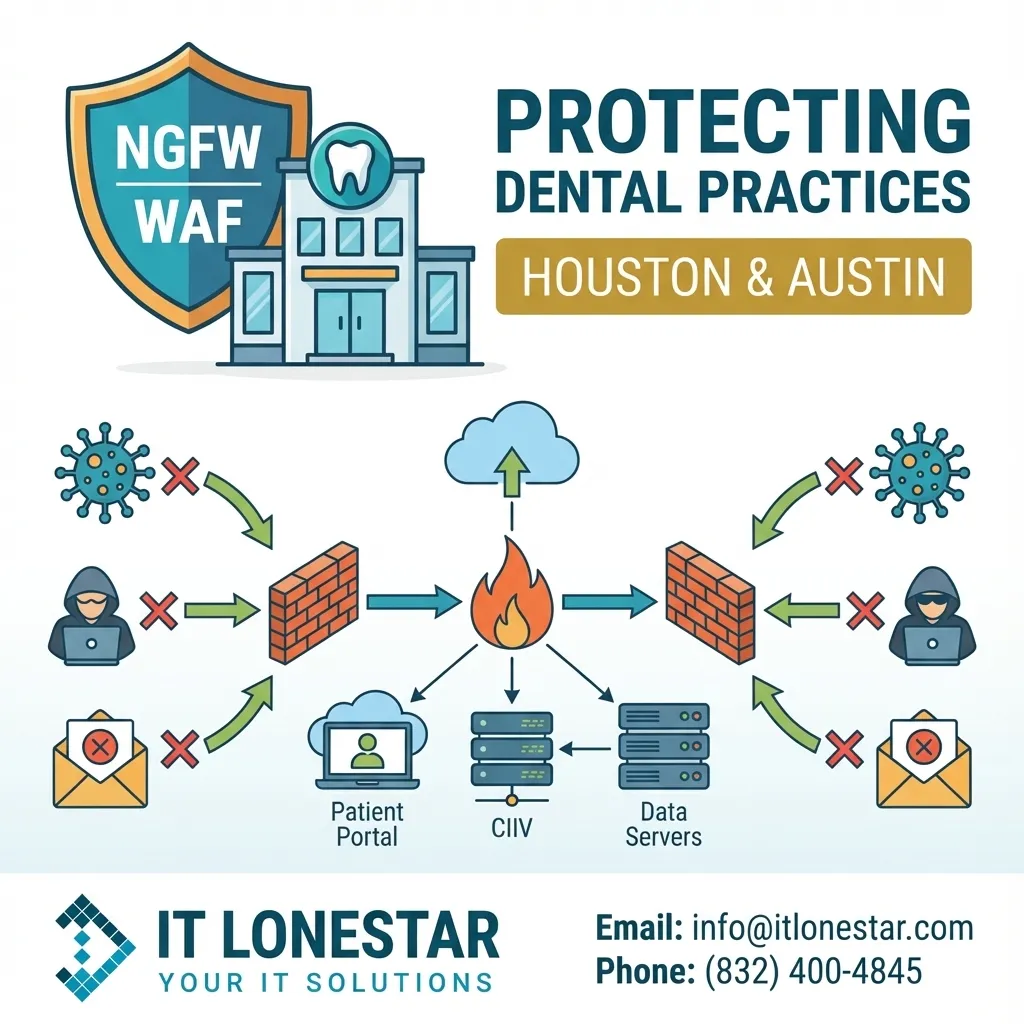
This article explains how IT LONESTAR uses next‑generation firewalls (NGFWs) and Web Application Firewalls (WAFs) to protect dental practices in Houston and Austin from cyberattacks, data breaches, and online threats targeting their networks, cloud apps, and patient portals.
Why this happens
Dental practices in Houston and Austin increasingly rely on cloud‑based practice management systems, online patient forms, imaging software, VoIP phones, and patient portals. This digital transformation has expanded their attack surface. Threat actors now actively target small and mid‑size healthcare providers because they often:
1. Store valuable ePHI and financial data
2. Run outdated servers, workstations, or firewalls
3. Lack dedicated cybersecurity staff
4. Use web‑based portals that aren’t properly protected
5. Depend on remote access for billing, providers, and insurance portals
Traditional, router‑style firewalls only filter basic IP and port traffic. They cannot fully inspect encrypted traffic, block web‑app attacks (like SQL injection or cross‑site scripting), or enforce granular security policies aligned with HIPAA and dental workflows. As a result, practices face growing risk of ransomware, account takeover, and data exfiltration without layered, modern controls.
IT LONESTAR focuses on dental practices in the Houston and Austin areas and has seen these exact pain points in local offices. Many come to IT LONESTAR after near‑miss incidents, failed backups, or suspicious login alerts. Those events expose gaps in perimeter security, internal segmentation, and web‑facing protections, demonstrating the need for strategically deployed NGFWs and WAFs managed by a specialized IT partner.
How we fix it
IT LONESTAR secures Houston and Austin dental practices with a layered firewall and WAF architecture designed specifically for healthcare and HIPAA environments.
1. Network Assessment for Dental Environments
- Map servers, imaging devices, sensors, and cloud apps
- Identify external exposure: remote access, patient portals, VoIP, email
- Review existing firewalls, rules, and VPNs
2. Deploy Next‑Generation Firewalls (NGFWs)
- Implement enterprise‑grade NGFWs at each practice location
- Enable deep packet inspection (including encrypted traffic)
- Apply intrusion prevention (IPS) to block exploits and zero‑day patterns
- Use application‑aware policies (block risky apps; prioritize dental apps)
- Segment clinical devices (x‑ray, CBCT, intraoral cameras) from admin PCs
- Enforce secure site‑to‑site and remote VPN access for providers and staff
3. Add Web Application Firewalls (WAFs)
- Place WAF in front of patient portals, online payment pages, and web forms
- Block SQL injection, XSS, bot attacks, and credential stuffing
- Rate‑limit suspicious requests and geofence traffic when appropriate
- Integrate with existing cloud platforms (Microsoft 365, practice portals, and hosted PM/EHR)
4. Continuous Monitoring and Management
- 24/7 monitoring of firewall and WAF alerts from our Texas security team
- Proactive rule tuning as threats evolve in the Houston and Austin regions
- Regular firmware updates, patches, and configuration backups
- Log retention and reporting aligned to HIPAA Security Rule expectations
5. Integration With a Complete Security Stack
- Advanced email security and phishing protection
- Endpoint protection and EDR for all Houston and Austin workstations
- Encrypted, tested backups and incident‑response playbooks for dental offices
Outcome for Dental Practices in Houston and Austin:
- Reduced ransomware and data‑breach risk
- Stronger HIPAA alignment and audit‑ready reporting
- More stable, faster networks for imaging and PM systems
- Peace of mind that IT LONESTAR’s local team is watching and adjusting protections every day.
IT LONESTAR combines NGFWs, WAFs, and ongoing management to deliver practical, affordable cybersecurity tailored to dental practices in the Houston and Austin metro areas.